
As T.S. Eliot nearly said, the naming of cars is a difficult matter.* They say that having the wrong name for a car can make or break it, so the marketing team probably spend a fair amount of time picking the name for a new model. Or at least you would hope so.
We wonder why, therefore, General Motors have eschewed the Holden name in favour of Opel. That’s what they’ve done with the launch of the Opel brand in Australia this month, marketing four models.
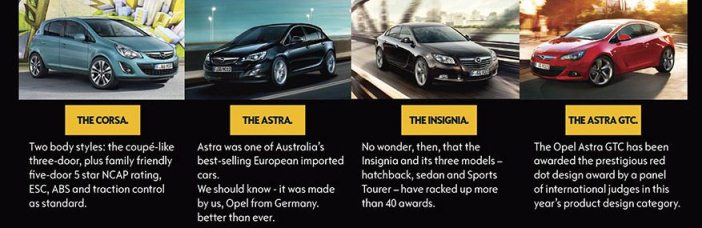
Opel is a German brand owned by General Motors, so really it’s a Holden. In fact Holden have sold Opels before as Holdens. They’ve also re-branded Chevrolets, Vauxhall, Isuzu and Daewoo as Holdens for the home market.
Is it because they think that the ‘German’ name is synonymous with quality, and they can therefore get a premium price? Mmm, perhaps, and their Oz slogan ‘Wir lieben Autos” (we love cars) suggests that’s the case (to say nothing of the German accent in the TV ads!). But then the Astra is made in China, Poland and the UK as well as Germany, so there’s no guarantee ‘our’ Opel is made in Germany. I wonder if GM, Holden or Opel would care to comment?
The intoduction of the Opel name to the Australian motorist makes me wonder how the marketing guys come up with some of these names.
Some car marques, especially the European ones, make things easy on the marketing team and simply stick to a series of numbers and letters. BMW and Mercedes are particularly good at this, and once you’ve figured out how the code works, you know exactly what’s what with the car. For example, in the BMW 320D, the 3 indicates the series (3-series) while the other numbers indicate the engine size. The D on the end means that it runs on diesel. And if you have an M and just one number such as M3, you know, as Edward Cullen informs Bella Swann in the first Twilight book, that it’s a fast, luxurious and powerful car (incidentally, the Twilight books – not sure about the movies – devote a fair amount of time to cars for a soppy romance story aimed at teenage girls. A new target market, maybe?). Other manufacturers who have cottoned onto the numbers and letters idea include Volvo, Audi, Jaguar and (a departure from Europe) Lexus. Mazda has also recently got on board the letters and numbers bandwagon, probably after some of the clangers mentioned below.
And that’s all very well and it does avoid problems and embarrassment by giving your brand new car a name that sounds silly or can’t be pronounced. However, for a lot of people, buying a car is an emotional decision and there’s nothing like a name or a word to stimulate the imagination. And actual names have another advantage for marketers: they’re easy to remember and get into the public’s heads via ads.
Successful car names that actually mean something tend to fall into several major categories. The first, popular with sports cars, is the “fast, dangerous animals” category. The winner here is Jaguar, which has an entire marque named after a big cat. Other worthy contenders include the Ford Falcon, Hyundai Tiburon (Shark in Spanish) and the Porsche Cayman (a caiman is a crocodile sort of thing). Or they have adventurous sorts of names like the VW Touareg (named after the desert nomads), Nissan Safari and Land Rover Discovery. Or they go for something that sounds upmarket (Holden Statesman) or like something to aspire to (Mitsubishi Aspire). Or they try to make you smile, like the Honda Jazz or the Fiat Panda.
Often, however, the people dreaming up the names tend to come up with things that sound a bit like real words or real words put together. Examples of this sort include Toyota’s Presara and Hiace. I’m not sure how they come up with these things. Apparently the marketing folk come up with screeds of suggestions that get slowly whittled down by the Powers That Be to a final solution. I sometimes wonder if they write down a list of suitable and appropriate words while sober, then get drunk and attempt to re-write the list with one person reading them out and the other person writing them down.
And the process does seem to come up with some odd results. We’ve probably all heard the story about the poor old Mitsubishi Pajero and how it’s supposed to mean “wanker” in Spanish. This didn’t stop it selling reasonably well in Spanish-speaking Bolivia, which is where this writer was living when the Pajero came out. After all, a good car is still a good car in spite of the name – the HSV is still popular, probably even with doctors, even though these initials being standard medical speak for the Herpes Simplex Virus. But the theory about the naming team getting drunk seems to be the only explanation for things like the Suzuki Kizashi, the Nissan Qashqai (that’s its overseas name – but is “Dualis” really that much better, sounding very close to Cialis?), Hyundai Getz, Ssangyong Kyron and the Toyota Yaris. Either that or someone was trying to get rid of high-scoring Scrabble letters.
The oddest car names are, like the ugliest cars, a matter for debate. And some really peculiar ones never make it out of Asia (e.g. the Honda Life Dunk or the Mitsubishi Mini Active Urban Sandal). But the following certainly deserve some (dis)honourable mention in this category (incidentally, I have owned at least two of the cars on this list at some stage):
- AMC Gremlin
- Mazda Bongo Friendee
- Mazda Marvie Proceed
- Isuzu Mysterious Utility Wizard (and MU isn’t much better than Mysterious Utility)
- Dodge Swinger
- Toyota Cressida (Cressida being a Shakespeare gal known for being unreliable and faithless)
- Isuzu Giga 20 Light Dump
- Daihatsu Naked
- Ford Pinto (a bean, a horse, Spanish for pint or “I paint” or Portugese for penis).
- Nissan Homy (yes, that is an M for Mike, not an R and an N close together)
More exist. Send us your suggestions, along with your ugly cars!
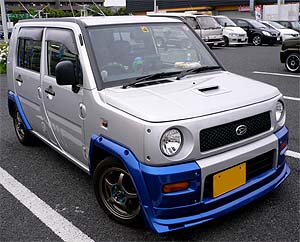
- Daihatsu Naked – We all know sex sells, but this is ridiculous.
*What the poet actually said was “the naming of cats is a difficult matter”.